
Introduction
In the power tool industry, chargers are often underestimated — yet they are one of the most critical components affecting performance, safety, and customer satisfaction.
For OEM buyers, distributors, and tool brands, ensuring power tool charger compatibility is not just about “making it work.” It directly impacts:
Product reliability
Battery lifespan
Safety compliance
After-sales costs
This guide explains how to ensure charger compatibility with different battery packs, from engineering fundamentals to real-world application.
What Does Charger Compatibility Really Mean?
Charger compatibility is the ability of a charger to correctly identify, communicate with, and safely charge a battery pack under all operating conditions.
A compatible system must ensure:
Correct voltage and current delivery
Safe thermal behavior
Proper charging algorithm execution
Stable physical connection
👉 In simple terms:
Compatibility is not just electrical — it is electrical + mechanical + software integration.
1. Voltage Matching: The First Critical Check
Why It Matters
Every battery pack is designed with a specific nominal voltage and charging voltage range.
Examples:
12V systems → ~12.6V charging voltage
18V systems → ~21V charging voltage
If the charger output does not match:
⚠️ Overvoltage → battery damage or safety risk
⚠️ Undervoltage → incomplete charging or inefficiency
Engineering Tip
A professional power tool charger manufacturer will always design with:
Tight voltage tolerance
Dynamic voltage regulation under load
2. Battery Chemistry Compatibility
Different battery chemistries require completely different charging logic:
| Battery Type | Charging Method |
|---|---|
| Li-ion | CC/CV (Constant Current / Constant Voltage) |
| NiMH | Delta-V detection |
| NiCd | Timed / temperature-based |
Key Risk
Using the wrong charger for the battery chemistry can lead to:
Reduced battery lifespan
Overheating
Safety hazards
Best Practice
Ensure the charger is specifically designed for:
Lithium-ion packs (most modern power tools)
Or legacy NiMH/NiCd systems if applicable
3. Connector & Pin Configuration
The Hidden Compatibility Factor
Even if voltage is correct, physical connection defines real compatibility.
Key factors include:
Pin layout and spacing
Contact resistance
Locking mechanism
Anti-reverse insertion design
Advanced Consideration
Modern battery packs often include:
Temperature sensing pins
Data communication pins
👉 If these are not correctly matched, the charger may:
Fail to start charging
Misread battery status
4. Charging Algorithm & Communication Protocol
Why Basic Chargers Fail
Low-end chargers simply supply power.
Professional chargers communicate and adapt.
A Proper Charging Algorithm Includes:
Pre-charge (for deeply discharged batteries)
Constant current phase
Constant voltage phase
Termination logic
Temperature feedback
Advanced Systems May Include:
MCU-controlled charging logic
Battery identification
Adaptive charging based on battery health
5. Thermal Management & Safety Protection
Heat = The Silent Killer
Charging generates heat, especially in:
Fast charging systems
Multi-channel chargers
Without proper design:
Battery degradation accelerates
Safety risks increase
Essential Protections
A reliable charger must include:
Over-voltage protection (OVP)
Over-current protection (OCP)
Over-temperature protection (OTP)
Short-circuit protection
6. Multi-Channel Charging Compatibility
For contractors and heavy users, multi-battery charging stations are essential.
Key Challenges
Power distribution between channels
Heat accumulation
Independent charging control
Solution
A well-designed system should support:
Independent channel management
Load balancing
Stable output across all ports
Real Customer Case
Case: European Power Tool Distributor
Challenge:
A distributor sourcing chargers from multiple suppliers faced:
High return rates
Battery overheating complaints
Inconsistent compatibility across models
Solution:
We redesigned their charger system with:
Custom pin structure
Optimized CC/CV charging algorithm
Improved thermal layout
100% testing process
Result:
🔻 Return rate reduced by 35%
🔋 Battery lifespan improved
📈 Customer satisfaction increased
Our Compatible Charging Solutions
As a professional manufacturer, we provide custom-compatible solutions for different battery systems.
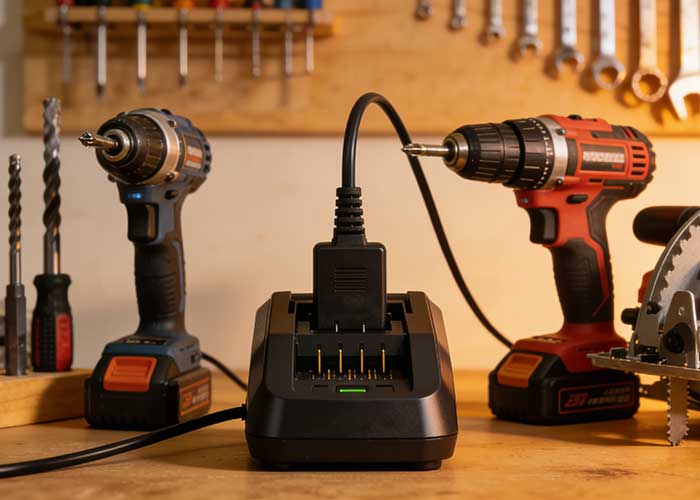
·Single-slot and multi-slot chargers
·Fast charging with optimized algorithms
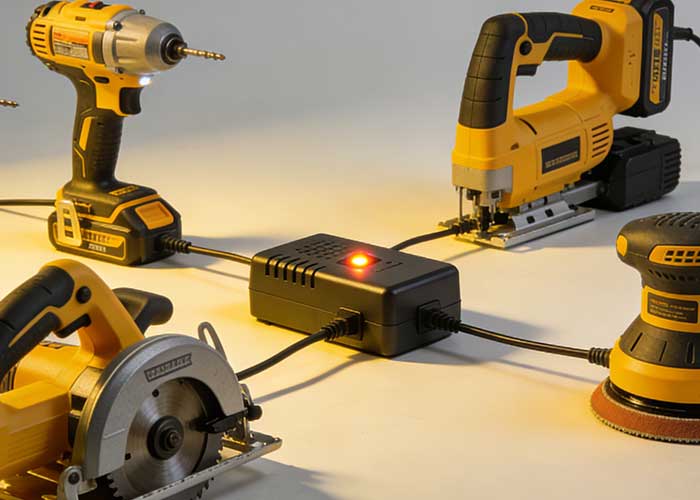
·Multi-channel charging stations for industrial use
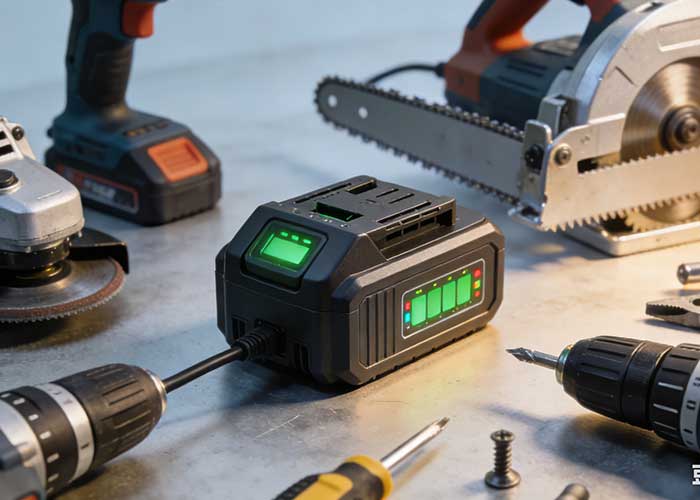
·Matched battery pack design
·Integrated protection systems
·Stable discharge and charging performance
Common Mistakes Buyers Make
Choosing chargers based only on price
Ignoring charging algorithms
Overlooking connector precision
Using generic “compatible” chargers without validation
👉 These often lead to higher long-term costs.
FAQ – Technical & Buyer Questions
1. Can one charger work with all battery packs?
Not always. Compatibility depends on voltage, chemistry, pin layout, and communication protocol.
2. How do I verify compatibility before mass production?
You should:
Test with real battery packs
Validate charging curves
Perform thermal and aging tests
3. Is fast charging harmful to batteries?
Not if properly designed.
A well-optimized charging algorithm balances speed and battery lifespan.
4. What is the biggest risk in incompatible chargers?
The biggest risks include:
Overheating
Battery damage
Safety incidents
5. Can you customize chargers for our existing battery system?
Yes. We provide:
Reverse engineering
Custom pin & structure design
Charging algorithm optimization
Conclusion
Ensuring power tool charger compatibility is a multi-dimensional engineering task involving:
Electrical matching
Mechanical design
Software control
Safety systems
For B2B buyers, choosing the right partner means:
Not just getting a charger — but ensuring a reliable, scalable, and market-ready power solution.